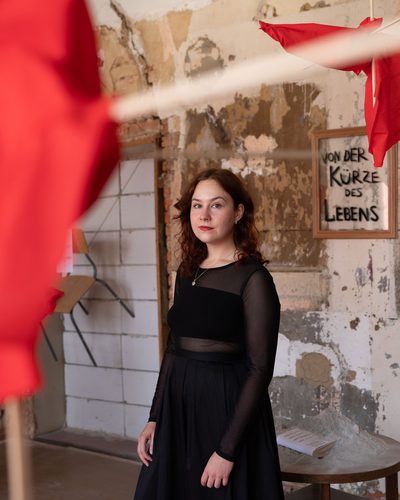
Marta Kowalczuk
Marta Kowalczuk studied composition with Michael Obst in Weimar, with Gordon Kampe in Hamburg and Baroque violin at the Academy of Music in Wrocław (Poland).
As a composer and baroque violinist, she creates a bridge between past and present. Her focus is on combining baroque instruments with historical performance practice, while also experimenting with diverse tones and textures. Inspired by spectral music, she expands the sonic possibilities of her compositions.
Marta actively engages in musical life in Germany and abroad, collaborating with esteemed orchestras, ensembles, conductors, and musicians like Staatskapelle Weimar, KNM Berlin, Ensemble via nova, MDR Sinfonieorchester, Ensemble Garage, Kent Nagano, Dennis Russell Davies, and Ensemble Resonanz. She has received numerous awards, including the Frost School of Music Ensemble Ibis Competition (2021, Miami USA), German Film Music Award (2022), and Flute New Music Consortium Composition Competition (2023). Marta was a fellow at Künstlerhof Schreyahn (2022/2023) and the Fleetstreet Residency Hamburg in February 2023.
Three months at Zvjezdane Staze as one of the five artists of the first season, selected through the Open Call 2024.
Concept
I plan to compose a new piece for accordion and guitar in the summer of 2024, and to extend an already composed piece “shadows, glimmers, and apparitions: the two voices” for three violins. In the composition for accordion and guitar, I aim to evoke a variety of atmospheres and timbres reminiscent of music box melodies and delicate children's songs. The accordion, with its dynamic range and expressive capabilities, will allow for moments of bold, resonant sound, while the guitar will provide a nuanced and delicate texture. My goal is to craft an atmosphere that oscillates between gentle, introspective passages and more pronounced and robust sections. At this early stage, I am leaving the direction of this piece open-ended to allow for organic inspiration and development.
One of my key sources of inspiration will be children's songs or lullabies from the traditional music of Bosnia and Herzegovina. The rich cultural heritage of this country, with its blend of diverse musical influences, provides fertile ground for creative exploration. Collaborating with local musicians and culture will be crucial in bringing authenticity and depth to this composition. To further enrich the sonic palette of the new work, I plan to experiment with minor preparations on the guitar to approximate the sound of the Šargija. This technique will allow me to infuse the piece with unique tonal colors while maintaining a contemporary edge.
“With this composition, I wanted to capture the contrasts that I encountered in Bosnia and Herzegovina. The music captures the landscapes, history, and people who influenced me during this period.”
During and after the residency
External
.png)
The residencies of the first season of Zvjezdane Staze (2024) were funded by the European Union under the Culture Moves Europe programme, implemented by the Goethe-Institut. Views and opinions expressed are those of the author(s) only and do not necessarily reflect those of the European Union or the Goethe-Institut. Neither the European Union nor the granting authority can be held responsible for them.